
The Cabinet Committee on Economic Affairs (CCEA) on Wednesday approved a five-year-long reform-based result-linked power distribution scheme worth Rs 3.03 lakh crore, for strengthening system of utilities to improve efficiency. Briefing after the CCEA meet here, Power and New & Renewable Energy Minister R K Singh said, "We have done a lot for power distribution reforms. It needs to be strengthened. Today, the Cabinet has approved the new scheme worth Rs 3.03 lakh crore, including Rs 97,000 crore central outlay." He said the funds would be given to power distribution companies (discoms) to strengthen their system.
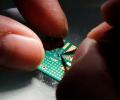
The exclusive club that dominates the global semiconductor fab scenario is about to get a new member. Taiwan, South Korea, and China control nearly 70 per cent of the global capacity. SEMI, the global industry body for semiconductor and electronics design and manufacturing, projects all fabs collectively will churn out 30 million wafers a month this year.

The government is close to approving a proposal by Micron Technology to set up an assembly, testing, marking and packaging (ATMP) facility in the country involving an investment of about $1 billion. The world's fifth largest semiconductor company, based in Idaho, USA, will use the facility to process some of its own wafers, manufactured across the globe.

But it may come with a downside risk of further rise in prices of several products.

Tata Group is in discussions with some major international companies, including those from Taiwan, for its foray into the semiconductor chip business. The Union government had earlier tried to bring in Taiwanese manufacturers Taiwan Semiconductor Manufacturing Company (TSMC) and United Microelectronics Corporation (UMC) for chip manufacturing in India. A person close to the development said the Tatas have now opened a separate channel for a possible tie-up. Currently, India mostly imports chips, which are fabricated and assembled to put into various applications, including automobiles, renewable power, mobile phones, televisions, and other electronic items.

Bajaj Auto and TVS Motor are the largest exporters in the listed space with export revenues of Rs 12,000 crore and Rs 5,000 crore.

OSAT majors have concerns about India's ability to provide a stable, predictable, and lasting policy environment for years to come, which is key for making a decision in a capital-intensive business.

Under the scheme, the government provided incentives of $1,000-5,600 directly to those buyers who were willing to trade their old, gas-guzzling vehicles for new, fuel-efficient vehicles. Indian auto bigwigs, including Tata Motors and Mahindra & Mahindra, among others, through the association of the Society of Indian Automobile Manufacturers (Siam), had approached the government to implement a similar programme. However, they are yet to succeed.

Currently, banks are closed every second and fourth Saturday of a month. Why shouldn't they be shut every Saturday? When most customers carry their banks in their pocket (the app on the mobile phone), there is no need to keep banks open on Saturdays, argues Tamal Bandyopadhyay.

The government will undertake a detailed evaluation of applications it has received in response to the mega semiconductor scheme and expects to complete the entire process and sign agreements with companies in next 8-10 months, according to Union Minister for Electronics and IT Ashwini Vaishnaw. Vaishnaw said he is happy with the response that came in within a short period of time, when the ministry invited applications under the Rs 76,000 crore semiconductor programme. The government is confident of seeing one of the big global players in semiconductor industry coming in the next round, Vaishnaw told PTI in an interview. He asserted that many other players too are "seriously evaluating" India's semiconductor programme, and that the ministry is in discussions with several companies.

Tata-owned Air India has launched a Voluntary Retirement Scheme (VRS) for its employees- in the airline's first drive to reduce headcount. The salt-to-steel conglomerate acquired the carrier last year. As of November 2019, the airline had 9,426 permanent employees.

'Our plan to set up a semiconductor facility in India is back on the table'

Micron plans an assembly testing, marking and packaging project of $1 billion, and talks are on to set up a memory chip plant for captive requirements.

A survey, with over 3,700 respondents across digital platforms, found that transparent taxation has been one of the most significant initiatives of the government followed by the production-linked incentives (PLI) scheme, equalisation levy and new labour codes.

Welcoming the latest round of stimulus announced by Finance Minister Nirmala Sitharaman on Thursday, experts said the measures will support the economic recovery boosting demand, job creation and by providing funds to the MSME and stressed sectors. The fiscal impact of the stimulus is likely to be around 0.25-0.6 per cent of GDP in the current fiscal, they said.

Finance Minister Nirmala Sitharaman on Monday held a meeting with representatives of the semiconductor industry of the US and invited them to make further investments in India. The finance minister spoke about opportunities for companies situated in Silicon Valley and about the government of India's commitment to be a reliable player in the entire semiconductor value chain with dedicated incentive for the sector in mission mode through the Indian Semiconductor Mission. Last year, the government approved a Rs 76,000-crore scheme to boost semiconductor and display manufacturing in the country in a bid to position India as a global hub for hi-tech production, and attract large chip makers.

Apple is hoping to assemble in India 25 per cent of all iPhones produced globally to reduce its heavy dependence on China.

7 key areas that the Budget must address to re-energise the infrastructure sector, suggests Vinayak Chatterjee.

The scheme is the biggest fiscal component of the Rs 20-lakh crore Aatmanirbhar Bharat Abhiyan package announced by Finance Minister Nirmala Sitharaman last month.

Finance Minister Nirmala Sitharaman on Thursday announced a new job creation scheme by giving subsidy to those establishments that make new hires. The subsidy would be to cover for retirement fund contributions by employees as well as employers for two years, she said. Employees contribution (12 per cent of wages) and employer's contribution (12 per cent of wages) totalling 24 per cent of wages would be given to establishments for two years, she said. Under the Aatmanirbhar Bharat Rozgar Yojana, every Employees' Provident Fund Organisation (EPFO)-registered establishment taking new employees would get this subsidy.

It, however, does not manufacture devices on its own and rather does it through contract manufacturers.
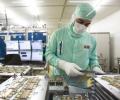
Mumbai-based Indian Semiconductor Manufacturing Company (ISMC) and Singapore-headquartered IGSS Ventures have one strategy in common: They have told the government in their application for semiconductor fabrication plants that they will export the bulk of the chips they make in India in the initial five or 10 years. The third applicant, Vedanta-Foxconn, which is also building a fab plant, has said it will concentrate on the needs of consumer electronics and mobile device markets, and earmark 80 per cent of output for domestic consumption, but has not specified its customers. Finding a viable domestic market could well be the biggest challenge for India's renewed tryst with semiconductors. Fab plants do not sell directly to end users but to intermediary chip design companies - such as Qualcomm or MediaTek.
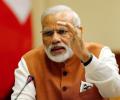
India is investing in developing indigenous capabilities in 5G and 6G telecom technologies besides focusing on manufacturing semi-conductors, Prime Minister Narendra Modi said on Thursday. In a virtual address at the Sydney Dialogue, the prime minister said the "greatest product" of technology today is data and that India has created a robust framework of data protection, privacy and security. "And, at the same time, we use data as a source of empowerment of people. India has unmatched experience in doing this in a democratic framework with strong guarantees of individual rights," he said.

Estimates suggest subsidy outgo on these proposals would be at least Rs 1,000 crore

Investors have gained Rs 335,770.71 crore in two days of market rally, with the Sensex scaling its fresh lifetime peak on Wednesday. Rising for the second day, the 30-share BSE benchmark jumped 476.11 points or 0.82 per cent to close at its new all-time high of 58,723.20. During the day, it gained 529.97 points to 58,777.06, its intra-day record.

According to officials in the state IT department, as part of the 2009 incentive scheme, the sop is currently available for all IT companies looking to set up or expand base in Kolkata.
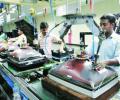
'The government expects demand for electronic products to reach $400 billion by 2023-24. This would be a huge foreign exchange outflow, which may further widen our trade deficit with other nations. Hence, the government plans to push local electronics manufacturing to cut down on their import bill.'

NTPC was the top gainer in the Sensex pack, jumping over 7 per cent, followed by Bharti Airtel, Titan, HCL Tech, SBI, PowerGrid, TCS and IndusInd Bank. NSE Nifty climbed 139.45 points to its new closing high of 17,519.45.

Apple and Samsung are international players and should work as a team with domestic companies to transform India into a global powerhouse: IT Minister Ravi Shankar Prasad.

Direct economic stimulus measures such as tax cuts for individuals and industry would have helped to prop up the Indian economy which was hit hard by the lockdowns across several states in India, say economists and corporate leaders. While the measures announced on Monday are focussed more on the supply side, these steps would take a lot of time to move the needle for the economy.

Congress on Monday announced a slew of populist measures including sops to farmers, students, unemployed youths, minorities, raising subsidised LPG cylinders from 9 to 12 and constitution of Vidhan Parishad in its manifesto for the Madhya Pradesh assembly elections.

The Delhi government will identify single-use plastic littering hotspots and the entry points of such items into water bodies and drains by October 31 this year, according to a draft action plan for the elimination of the environmentally hazardous products.

Narendra Modi might on Saturday ask the Apple CEO to make in India instead of importing and selling refurbished phones

The central government's highway award and construction target for the current fiscal is dominated by the Bharatmala scheme.

The commerce ministry wants the stimulus packages for exporters to continue for some more time till the sector recovers completely.

Fast-moving consumer goods companies have begun assessing the impact of the rate structure declared on Thursday under the goods and services tax.

Finance Minister Nirmala Sitharaman on Tuesday held a review meeting on credit guarantee scheme with heads of public sector banks, and asked them to expedite loan disbursement under the Rs 3-lakh crore ECLGS for MSME sector, hit hard by coronavirus-induced lockdown. The meeting on Emergency Credit Line Guarantee Scheme (ECLGS) was held through video conference, and the minister appreciated the efforts of banks in execution of the scheme.
After stiff resistance from its employees against a steep pay cut, National Aviation Company of India Ltd), which runs Air India, has come out with a fresh proposal to impose a 15-17 per cent cut on the total salary package.The total package includes basic salary, dearness allowance, house rent allowance and payments made under the productivity-linked incentive scheme . The cut, however, would not be applicable on 4000 employees.

The finance minister chaired a meeting through video conference with major private banks and NBFCs to ensure effective rollout of ECLGS and uninterrupted liquidity to Indian MSMEs in this difficult time.

As India emerges from the COVID-19 crisis, the ninth budget under the Modi government, including an interim one, is widely expected to focus on boosting spending on job creation and rural development, generous allocations for development schemes, putting more money in the hands of the average taxpayer and easing rules to attract foreign investments.
 © 2026 Rediff.com - Advertise with us - Disclaimer - Privacy Policy - Sitemap - Feedback - About us - Terms of use - Grievances